Water Extraction & Removal in Columbia, MD
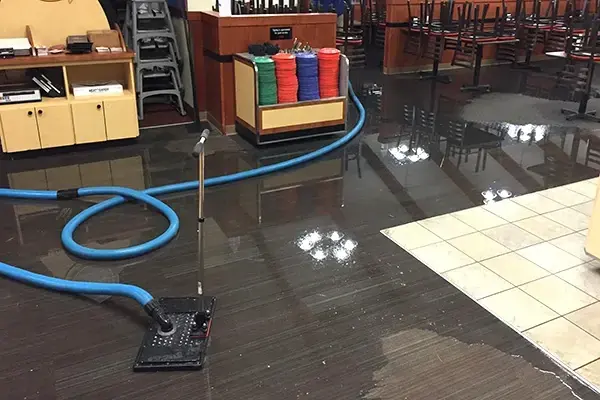
Standing water keeps moving into drywall, subfloor and the room next door. The extraction crew pulls it out with truck-mounted extraction, then the drying team sets equipment against a moisture map.
(888) 535-8182Get Columbia water extraction started- Truck-mounted extraction
- IICRC S500 drying standard
- Moisture mapping first
What to do the moment you find standing water
- Step 1Stop the source
Close the main shutoff, usually where the water service enters the basement or utility room.
- Step 2Kill power to wet circuits
If the panel sits in a dry spot, switch off the breakers for the flooded rooms. If the panel is wet, leave it alone.
- Step 3Stay out of deep water
Keep clear of standing water near outlets, cords and appliances.
- Step 4Photograph, then lift
Take photos before moving anything, then lift rugs, cushions and boxes off the wet floor.
Extraction is the cheapest drying there is. Every gallon the extraction crew pulls out as liquid is a gallon the dehumidifiers never have to pull out of the air, which is why the pump comes before the fans on a Columbia water loss.
What does water extraction & removal cost in Columbia, MD?
In Columbia, MD, water extraction typically runs $300 to $1,200 for a single room of clean water and $1,200 to $3,500 for a finished basement or several rooms. The water category, the square footage and how long the water sat drive the number.
- Category 1 from a supply line or overflow
- Hard floor or short carpet
- Extraction plus a moisture check
- Carpet and pad extraction
- Water under walls and cabinets
- Drying equipment set afterward
- Category 2 or 3 water
- Pad and porous materials removed
- Containment and antimicrobial
The drivers are the water category, the square footage, the material class and how fast drying started. For a planning range, try the water damage cost calculator.
How water extraction is handled in Columbia
- 1
Moisture map
The tech who does the walkthrough maps where the water went with pinless meters and thermal imaging before anything is moved.
- 2
Extract
The extraction crew runs truck-mounted extraction and weighted wands until the carpet and pad give up as much water as they can.
- 3
Set the drying plan
The drying team places air movers and LGR dehumidifiers to match the evaporation load of each room.
- 4
Read and verify
Readings go into the drying log every day until the wet materials match a dry reference in the same building.
The standard behind water extraction
Clean, gray or black water, set at the source and rechecked as it sits
Class 1 to 4, based on how much porous material got wet
Truck-mounted extraction, weighted wands, cavity drying tools
Wet materials within 2 to 4 points of a dry reference
Why extraction comes first in a Columbia home
Most Columbia houses and townhomes carry carpet over pad on a concrete slab in the lower level, and engineered wood or laminate over plywood upstairs. Both hold far more water than they appear to. A pad soaked by a supply line leak does not dry in place in any reasonable time unless most of that water leaves first.
- Truck-mounted extraction units move far more water than a shop vacuum and exhaust it outside.
- Weighted extraction tools press water out of carpet and pad instead of skimming the surface.
- Cavity drying tools pull water from under cabinets and behind baseboards.
What the extraction crew checks before the pump starts
The category of water decides the method. Clean water from a burst supply pipe is Category 1 at the source, but it degrades as it sits and touches building materials. Water from a washing machine or dishwasher is usually Category 2. Anything from a sewer, a floor drain backup or storm runoff through a window well is Category 3, and porous materials it touches get removed, not dried. The EPA notes on flood cleanup and indoor air explain why contaminated water changes the plan.
After the water is out
Extraction ends when the meters say the carpet and pad have given up what they can, not when the floor looks dry. The drying team then sets air movers and dehumidifiers, and the mitigation team checks the walls for water that wicked up behind the baseboard. If the source was a storm, the National Weather Service flood safety page is worth reading before the next one. Deeper drying is covered under structural drying, and lower levels have their own finished basement flooding page.
Related water damage services in Columbia
Columbia and Howard County
The Columbia restoration crew covers all ten Columbia villages, from Wilde Lake and Town Center to Long Reach, Owen Brown, Kings Contrivance and River Hill, with Ellicott City, Elkridge, Clarksville and Fulton close by.
Every village and ZIP coveredWater extraction questions in Columbia
How fast does standing water need to come out?
As soon as the source is stopped. Water keeps wicking into drywall, baseboard and subfloor for as long as it sits, and mold growth can start within 24 to 48 hours in a warm, humid Maryland summer. The extraction crew treats standing water as urgent for that reason.
Can a wet vacuum do the same job?
A shop vacuum helps with a small spill, but it removes a fraction of what a truck-mounted unit pulls and it leaves the pad saturated. Carpet pad and subfloor usually need professional extraction tools and a moisture reading to confirm the water is out.
Is the carpet saved after extraction?
Often, when the water was clean and extraction started early. Pad is usually replaced because it is inexpensive and holds water. Carpet touched by Category 3 water, such as sewage or storm runoff, gets removed.
Does extraction mean the house is dry?
No. Extraction removes liquid water. The water that soaked into framing, drywall and subfloor still has to evaporate, which is the job of the air movers and dehumidifiers over the following days.
Is water extraction covered by insurance?
Extraction after a sudden and accidental event, such as a burst supply pipe, is commonly part of a covered water claim, while rising surface water usually falls under flood coverage. Coverage depends on your policy, so it is worth checking with your own insurer.
What should I move before the extraction crew starts?
Only what is safe to lift: rugs, boxes, electronics and light furniture. Photograph everything first. Leave heavy furniture and anything near live outlets for the crew.
Standing water in a Columbia home or office right now?
(888) 535-8182Start the Columbia water removalStanding water in Columbia? Get it pulled out now.
The extraction crew removes the water, the drying team follows with air movers and dehumidifiers, and every reading goes into the claim file.