Finished Basement Flooding Cleanup in Columbia, MD
A finished lower level turns a small water problem into carpet, pad, drywall and framing problems. The restoration team extracts first, opens only what has to open, and dries the rest in place.
(888) 535-8182Get the Columbia basement dry-out moving- Flood cuts only where readings say
- IICRC S500 drying standard
- Claim-ready photo log
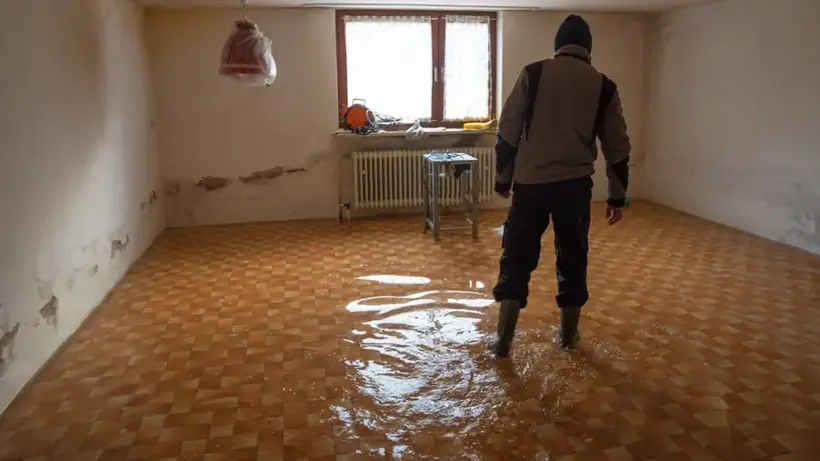
What to do the moment you find water in the basement
- Step 1Find where it is coming in
Look at the water heater, the washer, the sump pit, the floor drain and the window wells before anything else.
- Step 2Cut power if it is safe
Switch off lower-level circuits at a dry panel. Never step into water to reach a panel.
- Step 3Get valuables up
Lift boxes, electronics and anything cardboard onto shelves or carry them upstairs.
- Step 4Photograph the waterline
Take photos of the water height on walls and furniture before anything is moved.
Columbia builders finished a lot of lower levels. Many houses on sloped village lots have a walk-out basement with a family room, a bedroom or a home office, and townhome rows often put the laundry and water heater in a finished basement too. That is why basement water here is rarely just a concrete floor problem.
What does finished basement flooding cleanup cost in Columbia, MD?
In Columbia, MD, finished basement flooding cleanup typically runs $1,500 to $4,500 for clean water caught early and $4,500 to $12,000 or more when drywall, carpet and pad come out or the water was contaminated. Category, square footage, material class and how fast drying started set the range.
- Category 1 from a supply line or water heater
- Carpet lifted and dried, pad replaced
- Drywall dried in place
- Flood cuts along the wall base
- Carpet and pad removed
- Cavity drying behind paneling
- Category 3 from a drain backup or storm
- Porous materials removed
- Containment and antimicrobial
The drivers are the water category, the square footage, the material class and how fast drying started. For a planning range, try the water damage cost calculator.
How basement flooding cleanup is handled in Columbia
- 1
Stop and map
The tech who does the walkthrough confirms the source is stopped and maps moisture across floors and up the walls.
- 2
Extract and lift
The extraction crew pulls water from carpet and pad, then lifts or removes them based on the water category.
- 3
Open only what readings require
The mitigation team makes flood cuts only where the wall cavity reads wet, so drywall that tests dry stays up.
- 4
Dry and document
Air movers and LGR dehumidifiers run until readings match a dry reference, with a daily log for the claim.
The standard behind basement flooding cleanup
Category 1 from plumbing, Category 3 from drains and storm runoff
Usually Class 2 or 3 once carpet and wall bases are wet
Extraction, air movers, LGR dehumidifiers, cavity drying
Framing and subfloor within 2 to 4 points of a dry reference
How water gets into Columbia basements
- Water heaters and washer hoses failing inside the finished space.
- Sump pumps that fail or fall behind during a summer cloudburst.
- Window wells that fill and overflow into the room below.
- Floor drains that back up when the sewer lateral is blocked.
- Groundwater pushing through clay-heavy soil against the foundation wall after days of rain.
Each source brings a different category of water. A burst supply pipe starts as Category 1. A floor drain backup is Category 3 from the moment it appears, and the carpet, pad and drywall it touches come out. That is the rule under the IICRC S500 standard, not a sales decision.
What stays and what comes out
Drywall that reads dry above a certain height stays. The mitigation team cuts along the base of the wall only where the cavity is wet, usually 12 to 24 inches up, so insulation and the bottom plate can dry. Paneling, built-ins and bar cabinets get the same treatment: open the back or the toe kick, dry the cavity, keep what can be kept.
Keeping the next storm out
Once the room is dry, the causes deserve a look: the sump pump, the discharge line, gutter downspouts that dump next to the foundation, and window well covers. The Ready.gov flood page and Howard County Public Works both cover storm and drainage basics. Related work is covered under sump pump failure cleanup and sewage backup cleanup.
Related water damage services in Columbia
Columbia and Howard County
The Columbia restoration crew covers all ten Columbia villages, from Wilde Lake and Town Center to Long Reach, Owen Brown, Kings Contrivance and River Hill, with Ellicott City, Elkridge, Clarksville and Fulton close by.
Every village and ZIP coveredFinished basement flooding questions in Columbia
Does all the drywall in a flooded basement have to come out?
No. The mitigation team reads the walls and cuts only where the cavity is wet, usually along the bottom 12 to 24 inches. If the water was Category 3, such as a drain backup, every porous material it touched comes out.
Can basement carpet be saved?
Carpet soaked with clean water and extracted quickly can often be dried and relaid over new pad. Carpet touched by sewage or storm runoff is removed.
How long does a finished basement take to dry?
A contained loss usually dries in three to five days after extraction. Concrete, thick framing and tight rooms with little airflow can take longer. The equipment leaves when the readings say dry.
Is basement flooding covered by homeowners insurance?
A sudden plumbing failure inside the house is commonly covered, while groundwater and surface flooding usually are not without flood coverage, and sewer backup often needs its own endorsement. Coverage depends on your policy, so it is worth checking with your own insurer.
Why does the basement smell musty after it looks dry?
Water trapped under carpet pad, inside wall cavities or in the bottom plate keeps evaporating slowly. That is why moisture mapping and daily readings matter more than how the room looks.
What should I do while I wait for the restoration team?
Stop the source if you can, cut lower-level power at a dry panel, lift what you can off the floor, and photograph the water line on the walls.
Water across a finished lower level in Columbia?
(888) 535-8182Call about the flooded basementFinished basement under water in Columbia? Call now.
The restoration team extracts, opens only what the readings require and dries the lower level to the IICRC S500 standard.