Structural Drying & Dehumidification in Columbia, MD
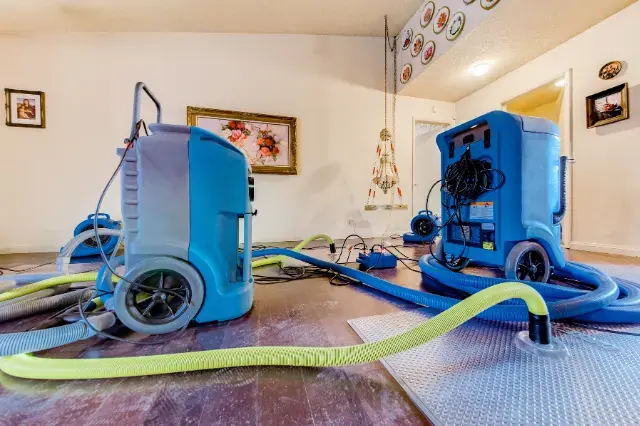
Surface dry is not dry. The drying team sizes air movers and dehumidifiers to each room, reads the framing every day and pulls equipment only when the structure matches a dry reference.
(888) 535-8182Get the Columbia structural drying started- IICRC S500 drying goal
- LGR and desiccant dehumidifiers
- Daily psychrometric logs
What to do the moment you find wet framing or subfloor
- Step 1Stop the water source
Drying cannot start until the leak, the overflow or the storm entry has stopped.
- Step 2Get standing water out
Extraction comes first. Every gallon removed as liquid is a gallon the dehumidifiers do not have to pull from the air.
- Step 3Close up the drying area
Keep doors and windows closed on humid Maryland days so the dehumidifiers work on the wet rooms, not the outdoors.
- Step 4Leave the equipment running
Air movers and dehumidifiers work around the clock. Turning them off overnight adds days.
Structural drying is the part of a water loss nobody sees and everybody pays for if it is skipped. Drywall can feel dry in a day while the bottom plate, the subfloor and the insulation stay wet for weeks.
What does structural drying & dehumidification cost in Columbia, MD?
In Columbia, MD, structural drying typically runs $1,200 to $3,500 for a contained Class 1 or 2 loss and $3,500 to $9,000 when several rooms, hardwood floors or Class 4 materials such as plaster and concrete need longer drying. Class, square footage, the number of equipment days and how fast drying started drive the range.
- Class 1 or 2 materials
- Air movers and one LGR unit
- Three to five days of readings
- Several rooms or wood floors
- Floor drying mats and cavity drying
- Extended equipment days
- Plaster, concrete, dense wood
- Desiccant dehumidification
- Longer drying and logs
The drivers are the water category, the square footage, the material class and how fast drying started. For a planning range, try the water damage cost calculator.
How structural drying is handled in Columbia
- 1
Moisture map
The tech who does the walkthrough maps wet materials with pinless meters, penetrating meters and thermal imaging and picks a dry reference.
- 2
Size the equipment
The drying team sets air movers to each room's evaporation load and sizes LGR or desiccant dehumidifiers to the Class of the loss.
- 3
Read every day
Temperature, relative humidity and material readings go into a daily psychrometric log.
- 4
Verify and pull
Equipment comes out only when wet materials read within 2 to 4 points of the dry reference.
The standard behind structural drying
Set by the source; drying starts after contamination is handled
Class 1 to 4, which sets the equipment count
Air movers, LGR and desiccant dehumidifiers, drying mats
Within 2 to 4 points of a dry reference, logged daily
How the drying plan is built
The IICRC S500 standard sorts a loss by Class, based on how much water the materials absorbed and how hard they are to dry:
- Class 1: a small area with low-porosity materials.
- Class 2: a whole room with carpet and wet walls up to about two feet.
- Class 3: water from above, soaked ceilings, walls and carpet.
- Class 4: dense materials such as hardwood, plaster, concrete and stone that hold water tightly.
The Class sets how many air movers and how much dehumidification a room needs. Class 4 materials often need desiccant dehumidifiers, which dry air further than refrigerant units, plus floor drying mats for hardwood.
Columbia humidity and the drying goal
Maryland summers are humid, and a lower level with the windows open can take on more moisture than it loses. The drying team closes the drying area and lets the dehumidifiers control the air. Readings are compared against a dry reference, a similar material in an unaffected part of the same house, and the goal is to land within 2 to 4 points of it. The EPA mold cleanup page explains why drying within the first day or two matters, and the EPA flood cleanup notes cover indoor air after water damage.
Why the log matters
The daily psychrometric log shows temperature, humidity and material readings for every day the equipment ran. It is the proof the structure is dry before the drywall is closed up, and it is one of the documents an adjuster expects in the claim file. Drying usually follows water extraction, and hardwood-heavy losses are common after burst pipes.
Related water damage services in Columbia
Columbia and Howard County
The Columbia restoration crew covers all ten Columbia villages, from Wilde Lake and Town Center to Long Reach, Owen Brown, Kings Contrivance and River Hill, with Ellicott City, Elkridge, Clarksville and Fulton close by.
Every village and ZIP coveredStructural drying questions in Columbia
What is structural drying?
Drying the building itself, the framing, subfloor, wall cavities and insulation, not just the visible surfaces. It is measured with meters against a dry reference, not judged by touch.
What does IICRC S500 mean?
IICRC S500 is the industry standard for professional water damage restoration. It sets how water is categorized, how drying is planned and how dryness is verified.
Why do the dehumidifiers run all night?
Evaporation never stops while materials are wet. Turning equipment off lets humidity climb and moisture move back into the materials, which adds days to the job.
Can hardwood floors be saved?
Often, when drying starts early and floor drying mats pull moisture from the boards. Cupping can relax as the wood dries. Boards that stay cupped or buckled may need replacement after drying.
How long does structural drying take?
A contained Class 1 or 2 loss usually dries in three to five days. Hardwood, plaster and concrete take longer. Equipment leaves when the readings say dry, not on a fixed schedule.
Is structural drying covered by insurance?
Drying after a covered sudden water loss is commonly part of the claim, and the daily log supports it. Coverage depends on your policy, so it is worth checking with your own insurer.
Walls or floors still wet after a water loss in Columbia?
(888) 535-8182Call about structural dryingNeed the structure dried, not just the surface? Call now.
The drying team sizes the equipment to the Class of the loss, reads the framing every day and verifies against a dry reference.